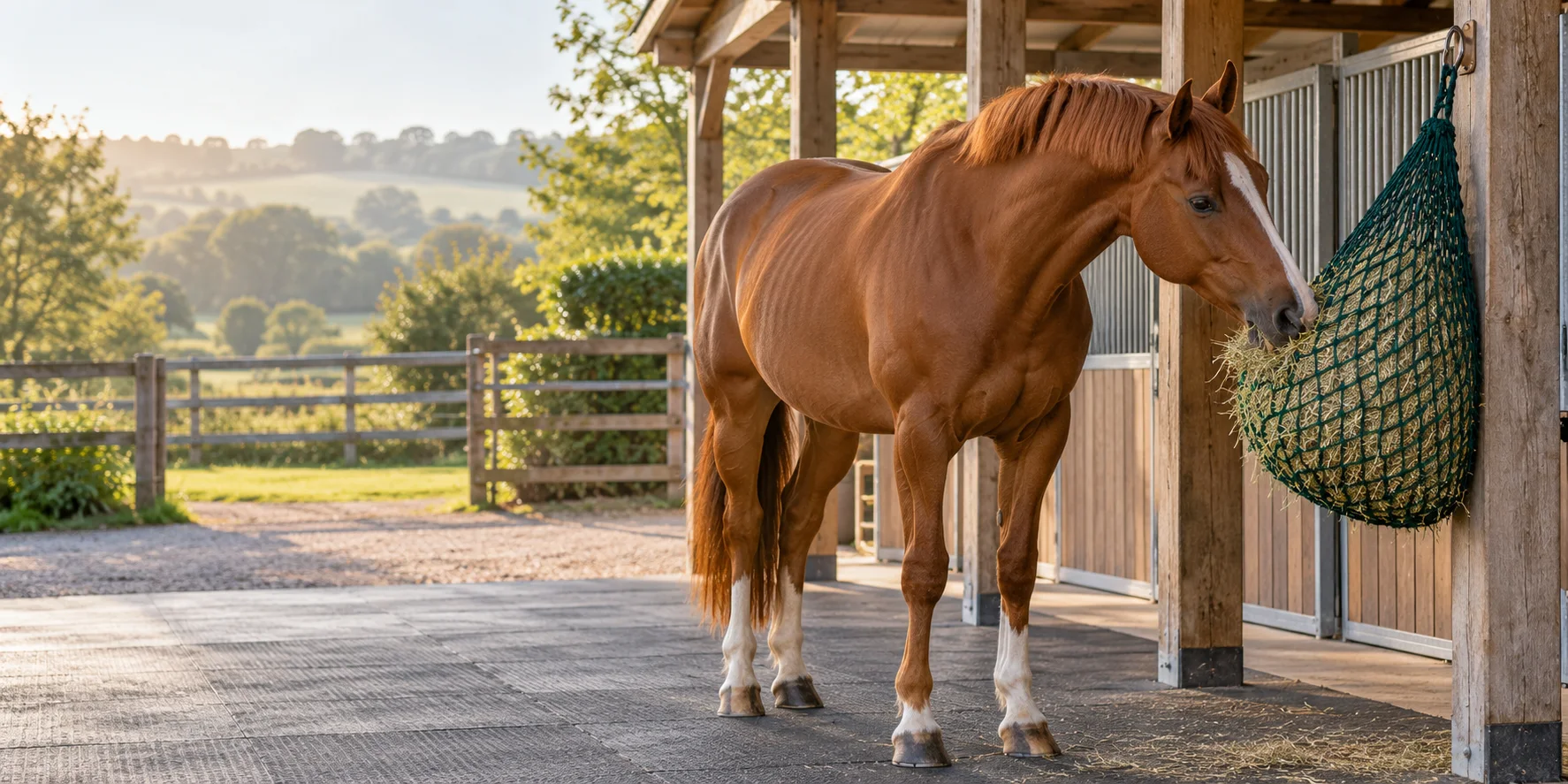
Slow-feed nets can extend eating time, but the smallest holes are not automatically the best choice. The horse must be able to use the net without excessive frustration, dental abrasion or a realistic chance of catching a shoe, hoof, leg or head in the mesh or tie cord.
What hole size changes
University of Minnesota research found that small- and medium-hole nets reduced intake rate and extended meal time compared with feeding off the ground or using large openings. In the cited study, one-inch openings produced the slowest rate, while 1.75-inch openings offered a middle ground. That result describes the tested adult horses and setup; it is not a universal prescription.
Horses new to slow feeding may need several meals to adapt. Watch whether the horse settles into a consistent rhythm or escalates into biting, striking or pulling the net. A slightly larger opening that is used calmly can be a better choice than a restrictive net that creates persistent frustration.
Mesh, knots and hardware
| Feature | What good looks like | What to avoid |
|---|---|---|
| Mesh | Consistent openings, smooth cord and reinforced high-load areas | Frayed strands, hard sharp knots or wire-coated grids near the mouth |
| Closure | A simple system with no dangling loops after filling | Long loose drawstrings accessible to feet or teeth |
| Hanging point | Rated anchor with an intentional breakaway element where appropriate | Improvised sharp hooks or hardware the horse can contact |
| Capacity | The weighed ration fits without forcing mesh wider | Overpacking that changes opening size and stresses seams |
Height is a safety compromise
Feeding closer to a natural head-down position can support airway drainage and a more typical posture, but a net low enough to catch a hoof or shoe creates a serious entanglement risk. Shod horses require particular caution. Setup must account for the individual horse, pawing behaviour, net type, shoes and the structure around it.
Never leave tie cords hanging. Inspect the net, attachment and surrounding wall or fence every day. Replace a damaged net rather than tying small loops or knots that change the hazard profile.
Measure whether it is working
- Weigh the forage rather than estimating by volume.
- Time several ordinary meals before and after introducing the net.
- Check for leftover hay, abnormal wear, frustration and changes in manure or condition.
- Inspect teeth and discuss feeding changes with the horse’s veterinarian or equine nutrition professional.
- Provide enough separate feeding stations for the social group and monitor displacement.
Net, bag or rigid feeder
A full net offers flexible capacity but requires careful suspension. A hay bag with a restricted front panel can contain hay more neatly but may feed from only one side. A rigid slow feeder can reduce net entanglement risk but introduces hard edges, grates and a different cleaning problem. The safest answer depends on the horse and installation, not simply the product category.
Further reading
University of Minnesota Extension: slow-feed hay-net research