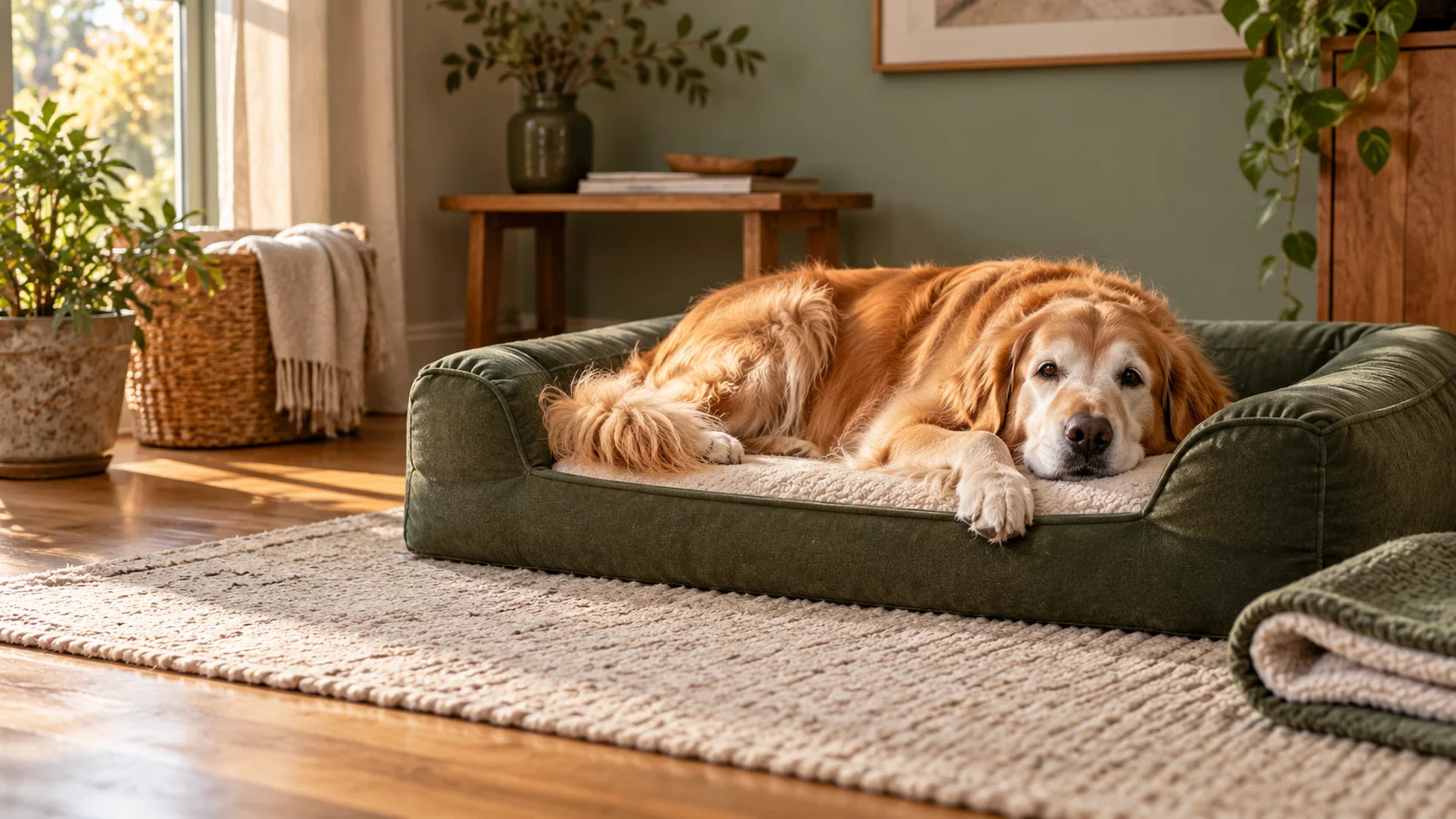
“Orthopedic” is not a regulated promise that guarantees a particular foam density, thickness or lifespan. The useful question is whether the finished bed keeps your dog comfortably supported without creating a difficult step, a hot sleeping surface or a cleaning problem you will eventually give up on.
Start with the dog’s sleeping position
A curled sleeper can use a smaller oval or bolstered bed than a dog who lies flat on one side. Measure from nose to rump while the dog is relaxed, then add room for legs and position changes. Product dimensions often include bolsters and outer walls, so compare the usable inner surface rather than the largest number in the listing.
For a dog with reduced mobility, a low or open entry can matter more than a high surrounding bolster. Watch how the dog approaches an existing bed: hesitation, circling without settling or choosing the floor may point to temperature, access or firmness—not stubbornness.
Foam construction and thickness
| Construction | Potential strength | What to check |
|---|---|---|
| Solid memory foam | Contours under body weight and can spread pressure | Density is often omitted; very soft foam can make standing harder |
| Layered foam | A comfort layer can sit over a firmer support base | Confirm the thickness of each layer, not only the total bed height |
| Shredded foam | Can be lighter and easier to reshape | Fill may migrate or develop low spots unless compartments control it |
| Raised cot | Airflow and a taut surface suit some warm environments | Step-up height, frame stability and replacement-fabric availability |
Press a hand firmly into the assembled bed and hold it there. If you can easily feel the floor, a heavy dog may do the same. A bed also needs a non-slip underside when used on tile or boards; sliding during entry can make an otherwise supportive design feel insecure.
Cleaning is part of the design
- The cover removes without forcing a large foam block through a tiny zipper.
- Care instructions state whether the cover can be machine washed and dried.
- A separate waterproof liner protects the foam from moisture and accidents.
- Replacement covers are available, or the shape accepts a simple fitted protector.
Waterproof and water-resistant are different claims. A coated cover may delay a spill while still allowing moisture through seams or zippers. If incontinence is a concern, use a washable absorbent layer above the bed as well as a protective liner around the foam.
Bolsters, heat and household fit
Bolsters offer a headrest and a sense of enclosure, but they reduce usable space and can block an older dog’s easiest route in. Thick memory foam can also hold warmth. Dogs that seek cool floors may prefer an open mattress, a breathable cover or a raised cot rather than the deepest plush option.
AKC guidance notes that size matters and that older dogs or dogs with joint problems may benefit from an orthopedic bed. That is a reason to evaluate access and support carefully, not a substitute for veterinary care when a dog is painful or has difficulty standing.
Before keeping the bed
Expand compressed foam for the manufacturer’s stated period, inspect the zipper and seams, and place the bed where your dog already chooses to rest. Keep packaging until you know the dog can enter, turn and rise comfortably. Recheck the bed over time for permanent depressions, exposed foam or a base that has begun to slide.